Virginia Bill of Rights Coalition

Restoring the Republic: Freedom, Liberty, Privacy.

Bill of Rights
Why Get Involved?
Local Resolutions
USA PATRIOT ACT
Action & Links

Please forward widely!

This Independence Day 2008, show your support for restoring America's promise of justice and the rule of law, as envisioned in the Declaration of Independence and embodied in the U.S. Constitution and Bill of Rights, by signing "A Declaration for Our Times."

BORDC is running the Declaration (see text below) as a signature ad in the New York Times the week of July 4.  We are also producing audio and video recordings of the Declaration that you can ask local radio and Public Access TV stations to run as Public Service Announcements.

Your name among hundreds of others from across the country will show America the breadth of support for demanding that our representatives uphold their oaths to protect and defend the Constitution.  And it will inspire others to support civic education, dialogue, and action in their communities by pledging their support for the People's Campaign for the Constitution.

To sign on, go to http://www.constitutioncampaign.org/ad/.  We ask individual signers to donate $25 or more, and organizations to donate $50-$500 to help us cover the $30,000 cost for the half-page ad.  You may contribute online or by mailing a check.

Please show your support for the Constitution AND help us reach our ambitious goal by signing on to the ad by Sunday, June 29, and urge your friends to do the same.

Thank you for all you do.

The Bill of Rights Defense Committee
www.bordc.org


Text of the Declaration signature ad (artwork coming soon at www.constitutioncampaign.org.):

When in the course of human events the government becomes destructive of the ends for which it was established, it is the Right of the People to alter it and demand restoration of those Constitutional Principles that have so long assured their Liberty, Safety, and Happiness.

Therefore, on the anniversary of our Independence, we offer this new declaration for our times.

The history of this president is one of arbitrary usurpations of power, the effect of which is to establish tyranny through false promises of greater security.

He has created a multitude of new programs and sent swarms of petty officers to spy on Americans in a misguided effort to combat foreign terrorism.  He has invested these agents with sweeping new powers to monitor our conversations and ransack our personal papers and effects without judicial supervision or any reason to believe - as the Constitution requires - that a crime has been committed.

He has further claimed the power to disregard legislation that Congress has passed.

He has suspended the laws and treaties against torture, authorized the kidnapping of mere suspects, and transported hundreds of prisoners beyond seas so that no independent judiciary could question the legality of their mistreatment.

He and his supporters in Congress have granted amnesty to the officials who unleashed torture and humiliation upon helpless prisoners, to the disgrace of our nation.

He has denied these prisoners access to attorneys, family, and friends, and has claimed the right to try them before military tribunals specifically designed to disregard the most basic principles of law.

He has imprisoned thousands of lawful immigrants for months without charges, under brutal conditions, until his agents, rather than independent courts, decided that they posed no threat.

He has wrapped his usurpations of power and his deprivations of liberty in thick cloaks of secrecy
, thereby showing contempt for the rule of law and the proper functions of Congress, the courts, and the press.  

At every stage of these oppressions we have sought redress, but our petitions have been answered only by repeated injury.  

We, therefore, resolve to resist these usurpations by all lawful means at our disposal. To this end, we insist that the powers of our national government be shared by all branches of government and not concentrated in one alone.  And we call upon Congress, the courts, and the press to reassert their constitutional functions vigorously and restore the promise that is America.

To these ends, we mutually pledge our lives, our fortunes, and our sacred honor.

By Christopher Pyle, with apologies to Thomas Jefferson

Sign on to this ad here.


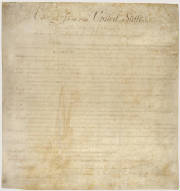
*The first ten Amendments (Bill of Rights) were ratified effective December 15, 1791.

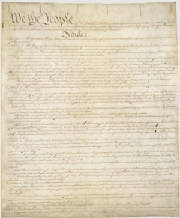
Amendment I.*

Congress shall make no law respecting an establishment of religion, or prohibiting the free exercise thereof; or abridging the freedom of speech, or of the press, or the right of the people peaceably to assemble, and to petition the Government for a redress of grievances.

Amendment II.

A well regulated Militia, being necessary to the security of a free State, the right of the people to keep and bear Arms, shall not be infringed.

Amendment III.

No Soldier shall, in time of peace be quartered in any house, without the consent of the Owner, nor in time of war, but in a manner to be prescribed by law.

Amendment IV.

The right of the people to be secure in their persons, houses, papers, and effects, against unreasonable searches and seizures, shall not be violated, and no Warrants shall issue, but upon probable cause, supported by Oath or affirmation, and particularly describing the place to be searched, and the persons or things to be seized.

Amendment V.

No person shall be held to answer for a capital, or otherwise infamous crime, unless on a presentment or indictment of a Grand Jury, except in cases arising in the land or naval forces, or in the Militia, when in actual service in time of War or public danger; nor shall any person be subject for the same offense to be twice put in jeopardy of life or limb, nor shall be compelled in any criminal case to be a witness against himself, nor be deprived of life, liberty, or property, without due process of law; nor shall private property be taken for public use without just compensation.

Amendment VI.

In all criminal prosecutions, the accused shall enjoy the right to a speedy and public trial, by an impartial jury of the State and district wherein the crime shall have been committed; which district shall have been previously ascertained by law, and to be informed of the nature and cause of the accusation; to be confronted with the witnesses against him; to have compulsory process for obtaining witnesses in his favor, and to have the assistance of counsel for his defence.

Amendment VII.

In Suits at common law, where the value in controversy shall exceed twenty dollars, the right of trial by jury shall be preserved, and no fact tried by a jury shall be otherwise reexamined in any Court of the United States, than according to the rules of the common law.

Amendment VIII.

Excessive bail shall not be required, nor excessive fines imposed, nor cruel and unusual punishments inflicted.

Amendment IX.

The enumeration in the Constitution of certain rights shall not be construed to deny or disparage others retained by the people.

Amendment X.

The powers not delegated to the United States by the Constitution, nor prohibited by it to the States, are reserved to the States respectively, or to the people.


***

A History of Limiting Civil Liberties (will we actually get anything different from a new Administation?)

Americans tend to think of civil liberties as fixed and immutable. In fact, they have expanded and contracted throughout the nation's history. Those freedoms have often been compromised during times of crisis and war.

1798: Congress passes the Alien and Sedition Acts in anticipation of war with France, restricting the rights of pro-French immigrants and the press.

1861: At the outset of the Civil War, President Lincoln suspends habeas corpus, allowing draft-resisters and Confederate sympathizers to be jailed indefinitely without charges.

1917: Congress passes the Espionage Act , which allows the government to prosecute almost any critic of World War I on charges of "insubordination" or "disloyalty." Post office refuses to distribute a popular leftist magazine, The Masses. A federal appeals court says the magazine does not speak with "the voice of patriotism" and therefore does not deserve to be distributed.

1918: The Espionage Act is tightened and becomes the Sedition Act . Socialist leader and four-time presidential candidate Eugene V. Debs is convicted of sedition and stripped of his U.S. citizenship for speaking out against the act . He remains in jail through the 1920 presidential election, in which he is also a candidate.

Jan. 2, 1920: Government agents in 33 cities round up thousands of foreigners suspected of being anarchists or communists, and hold many of them without charges for long periods. The sweep becomes known as the Palmer Raids, after Atty. Gen. J. Mitchell Palmer.

1940: Congress passes the Smith Act , formally known as the Alien Registration Act , which makes it a crime to advocate the overthrow of the U.S. government or to belong to any group that does so. After World War II, this law is used to prosecute suspected communists.

March 1942: The government establishes 10 relocation centers for 110,000 people of Japanese descent--U.S. citizens and Japanese nationals--and interns them for the duration of World War II. Congress offers a formal apology and compensation to the internees 46 years later, in 1988.

1956-71: FBI conducts counterintelligence operations against domestic dissidents under a campaign called COINTELPRO. Tactics include disinformation, infiltration and disruption of the activities of targeted groups, which are mostly on the political left. In 1974, the Justice Department says some of the operations could "only be considered abhorrent in a free society."

October 2001: Congress passes the USA Patriot Act, which creates a crime of domestic terrorism, authorizes "sneak and peek" searches conducted without the target's knowledge, broadens the government's power to monitor phone and Internet communications, and lets the attorney general detain any foreigner believed to threaten national security.


Paraphrasing remarks from Al Gore's speech at Constitution Hall in Washington DC on November 9, 2003...

Former Vice-President Al Gore stated:

…this Administration has attempted to compromise the most precious rights that America has stood for all over the world for more than 200 years: due process, equal treatment under the law, the dignity of the individual, freedom from unreasonable search and seizure, freedom from promiscuous government surveillance. And in the name of security, this Administration has attempted to relegate the Congress and the Courts to the sidelines and replace our democratic system of checks and balances with an unaccountable Executive. And all the while, it has constantly angled for new ways to exploit the sense of crisis for partisan gain and political dominance.
…many of the worst abuses of due process and civil liberties that are now occurring are taking place under the color of laws and executive orders other than the Patriot Act.
…the few good features of this law should be passed again in a new, smaller law -- but that the Patriot Act must be repealed.

There is still no serious strategy for domestic security that protects critical infrastructure such as electric power lines, gas pipelines, nuclear facilities, ports, chemical plants and the like.

They're still not checking incoming cargo carriers for radiation. They're still skimping on protection of certain nuclear weapons storage facilities. They're still not hardening critical facilities that must never be soft targets for terrorists. They're still not investing in the translators and analysts we need to counter the growing terror threat.

The administration is still not investing in local government training and infrastructures where they could make the biggest difference. The first responder community is still being shortchanged. In many cases, fire and police still don't have the communications equipment to talk to each other. The CDC and local hospitals are still nowhere close to being ready for a biological weapons attack.

The administration has still failed to address the fundamental disorganization and rivalries of our law enforcement, intelligence and investigative agencies. In particular, the critical FBI-CIA coordination, while finally improved at the top, still remains dysfunctional in the trenches.

The constant violations of civil liberties promote the false impression that these violations are necessary in order to take every precaution against another terrorist attack. But the simple truth is that the vast majority of the violations have not benefited our security at all; to the contrary, they hurt our security.

Recap of 2005

Bill of Rights Defense Committee PATRIOT Act Reauthorization Talking Points

- August 2005 -

Grassroots resolutions continue to exert a powerful effect on the national discussion.

The nearly 400 community civil liberties resolutions are having an effect on Congress. In 2001, only 66 members of Congress voted against the USA PATRIOT Act. On July 21, 2005, two-thirds of the 171 representatives who opposed PATRIOT Act reauthorization (HR 3199) represented districts with a combined total of more than 300 local resolutions. In the districts of the 257 representatives who supported HR 3199, only 85 resolutions had passed.

---

The Congressional process to reauthorize the PATRIOT Act has not been open or democratic.

Democracy has been undermined in the current rush to pass a bill reauthorizing the PATRIOT Act sections that expire at the end of 2005 in time for President Bush to sign it on September 11, 2005.

In the House of Representatives, HR 3199 was forced through on July 21 (in the wake of the London bombings, and on the same day a second set of bombs failed to detonate in London subways), without allowing votes on moderate amendments such as Rep. Sanders’ “Freedom to Read” amendment to exempt library and bookstore reading lists from Section 215. The Sanders amendment had passed in the House with a 51-vote margin on June 15. Three Republicans— Rep. Dana Rohrabacher (R-CA), Rep. Ron Paul (R-TX), and Rep. C.L. “Butch” Otter—voted “present” to signify their opposition to the partisan rule that determined which amendments could be voted on.

A more moderate reauthorization bill was passed in the Senate (S 1389) on the eve of the August recess by unanimous consent in a voice vote. A conference committee will reconcile HR 3199 and S 1389 into a single bill, on which the House and Senate are expected to vote after they return on September 6.

The rush to give the government more power is eerily similar to the time when the PATRIOT Act was rushed through in 2001, weeks after September 11th.

---

The minor adjustments to 16 expiring PATRIOT Act sections are not enough.

The reauthorization bills make only minor, superficial improvements to a few of the sections of the PATRIOT Act that expire at the end of this year, while making all but a few provisions permanent. Here is how the Senate bill would amend some of those sections:


· Section 213: Authority for Delaying Notice of the Execution of a Warrant (often called “sneak and peek”). Sets seven days as the limit for giving notice, but extends this limit indefinitely to a “later date certain if the facts of the case justify a longer period of delay.”

· Section 215, Access to Records and Other Items under the Foreign Intelligence Surveillance Act (FISA): Raises the standard for seeking records from "certification" to a "statement of facts” and requires that the FBI Director approve FISA requests for records sought from libraries or bookstores. However, both the House and Senate bills weaken the plaintiff’s ability to challenge a request by allowing him or her to do little more then file a challenge (plaintiffs or their attorneys may not address the court, for example).

· Section 505, National Security Letters. Gives the entity being asked to turn over customer records an opportunity to challenge the request in court, for example, on the grounds that it violates the entity's constitutional rights. The bill does not, however, provide a mechanism for considering the constitutional rights (such as the Fourth Amendment rights) of someone whose emails are intercepted. Furthermore, unlike the proposed amendment to Section 215 (see previous bullet), the amendment to this section contains no mechanism for making sure that the records sought have a connection to a terrorist or spy.

Not only will the PATRIOT Act reauthorization bills’ changes to the original bill be insufficient to protect civil liberties, but they fail to address many other sections of the PATRIOT Act that are already permanent. Among these are section 802, which defines the new crime of “domestic terrorism” so broadly that it can be used to arrest people exercising their First Amendment rights, and section 805, which expanded the definition of “material support for terrorism” to include providing expert advice and assistance.

Finally, the American people are concerned about many post-9/11 changes to laws and policies that are not part of the PATRIOT Act, such as the Attorney General’s restrictions on Freedom of Information Act (FOIA) requests and guidelines that allow spying on religious and political meetings without any evidence of wrongdoing; abuse of material witness authority such as in the Brandon Mayfield case; the ability of the President to designate U.S. citizens and foreign nationals as “enemy combatants” and to hold them indefinitely; the government’s use of secret evidence in court cases; blanket closures of immigration hearings; the use of torture in U.S. military prison facilities; and the CIA’s “extraordinary rendition” program, which has been called “torture by proxy,” among many other disturbing changes.

---

Most of the controversial PATRIOT Act will become permanent.

When the PATRIOT Act was rushed through Congress in October 2001, some members of Congress established sunsets on a few sections that threatened civil liberties. These are the kinds of provisions that should be looked at every few years, to make sure our rights are intact. But without evidence that these provisions have helped prevent terrorist attacks, the House reauthorization bill places new sunsets of ten years on only two sections—206 and 215—and makes the rest of the Act permanent. The Senate bill places four-year sunsets on only three sections (206, 215, and Lone Wolf).

---

Neither the Senate nor the House version of the reauthorization is ideal, but the Senate bill is preferable.

We support Senate language regarding PATRIOT Act sections 213 and 215, but more changes will be needed in the future to ensure civil liberties. We oppose new death penalties introduced in the House reauthorization bill. We also oppose giving the FBI the power to issue its own subpoenas. The power it seeks, known as “administrative subpoenas,” have been effective in giving administrative agencies the ability to obtain records to fulfill responsibilities such as providing oversight against fraud and wrongdoing on the part of the government and contractors to the government. The FBI is NOT an administrative agency.

---

Additional Talking Points

The grassroots movement to restore civil liberties is non-partisan.

Allies who are concerned about the Bill of Rights come from a wide spectrum of the population, including the American Civil Liberties Union, American Library Association, American Conservative Union, Americans for Tax Reform, Bill of Rights Defense Committee, Center for Constitutional Rights, Center for Democracy and Technology, Eagle Forum, Electronic Freedom Forum, Electronic Privacy Information Center, Friends Committee on National Legislation, Gun Owners of America, National Rifle Association, Patriots to Restore Checks and Balances, People For the American Way, Unitarian Universalist Association, and many other groups and individuals determined to protect our Constitutional guarantees.

---

The Administration continues to distort terrorism statistics by inflating convictions.

According to a series of Washington Post investigative reports in June 2005 (http://www.washingtonpost.com/wp-dyn/content/article/2005/06/11/AR2005061100381.html), contrary to President Bush’s assertion that the Justice Department has had 400 arrests and 200 convictions in the “war on terror,” there have actually been 330 arrests and only 39 convictions related to terrorism or national security. For those 39 convictions, the median sentence was a mere 11 months, which indicates a misdemeanor offense (rather than a felony). In fact, many of the cases revolved around non-criminal immigration violations or non-terrorist crimes. For more information, see BORDC’s companion guide http://bordc.org/resources/companion.php to the DOJ’s Report from the Field: The USA PATRIOT Act at Work.

---

The Justice Department continues to deflate its failures and human rights abuses.

Because the PATRIOT Act expanded the government’s ability to keep its actions secret from Congress and the American people, very little is known about how the government has used its expanded powers. The Justice Department and Republican members of Congress who support the Act state that there has not been a single instance in which anyone’s civil liberties have been abused. However, House Judiciary Democratic Staff have prepared a summary of abuses, which House Judiciary Committee Ranking Member Rep. John Conyers (D-MI) presented during the debate on HR 3199 on July 21. See http://www.bordc.org/resources/abuses.php.

One of the few stories that show possible abuses concerns Oregon Attorney Brandon Mayfield, a convert to the Muslim faith, whose fingerprint was falsely matched by the FBI to a print found on a bag of detonators linked to the 2004 Madrid train bombing. Although the government admits its mistake in matching Mayfield’s fingerprint and detaining him as a “material witness” for two weeks, it has made conflicting statements as to whether the PATRIOT Act was used to obtain warrants to secretly search Mayfield’s home and office. Although the government has apologized to Mayfield, it has tried to have his lawsuit against the government dismissed.

---

The Administration has never proven its need for the PATRIOT Act, or for any expansion of the Act, nor acted to ensure civil liberties.

Tools to fight terrorism already existed prior to September 11. What was needed, said the 9/11 Commission, was for law enforcement, intelligence, and national defense agencies to work cooperatively, instead of working in the atmosphere of an internal turf war. According to the Commission’s report, “The burden of proof for retaining a particular governmental power should be on the executive, to explain (a) that the power actually materially enhances security and (b) that there is adequate supervision of the executive’s use of the powers to ensure protection of civil liberties.” (p. 394-95).

The government has not met this standard. Although Congress’s intelligence reform legislation creates a new Privacy and Civil Liberties Board, the board is underfunded and lacks sufficient authority (subpoena power) to do its job. Furthermore, the board members, who were handpicked by President Bush, have not met in the nine months since Congress created the board.

---

The PATRIOT Act was sold to us as a weapon against terrorism, but it has been used primarily for nonterrorist offenses.

USA PATRIOT is an acronym for “Uniting and Strengthening American by Providing Appropriate Tools Required to Intercept and Obstruct Terrorism.” Yet the PATRIOT Act has been used for a Las Vegas political bribery sting at a strip club, to hunt down animal rights groups, to crack down on marijuana smugglers, and to seize money hidden overseas by alleged bookies, con artists, and drug dealers.